How it works

The art was always there.
You just needed to know.

An AI gives you an itinerary based on what millions of people have written about. Flâneur gives you a map of everything that actually exists in the city, and lets you decide what matters to you.

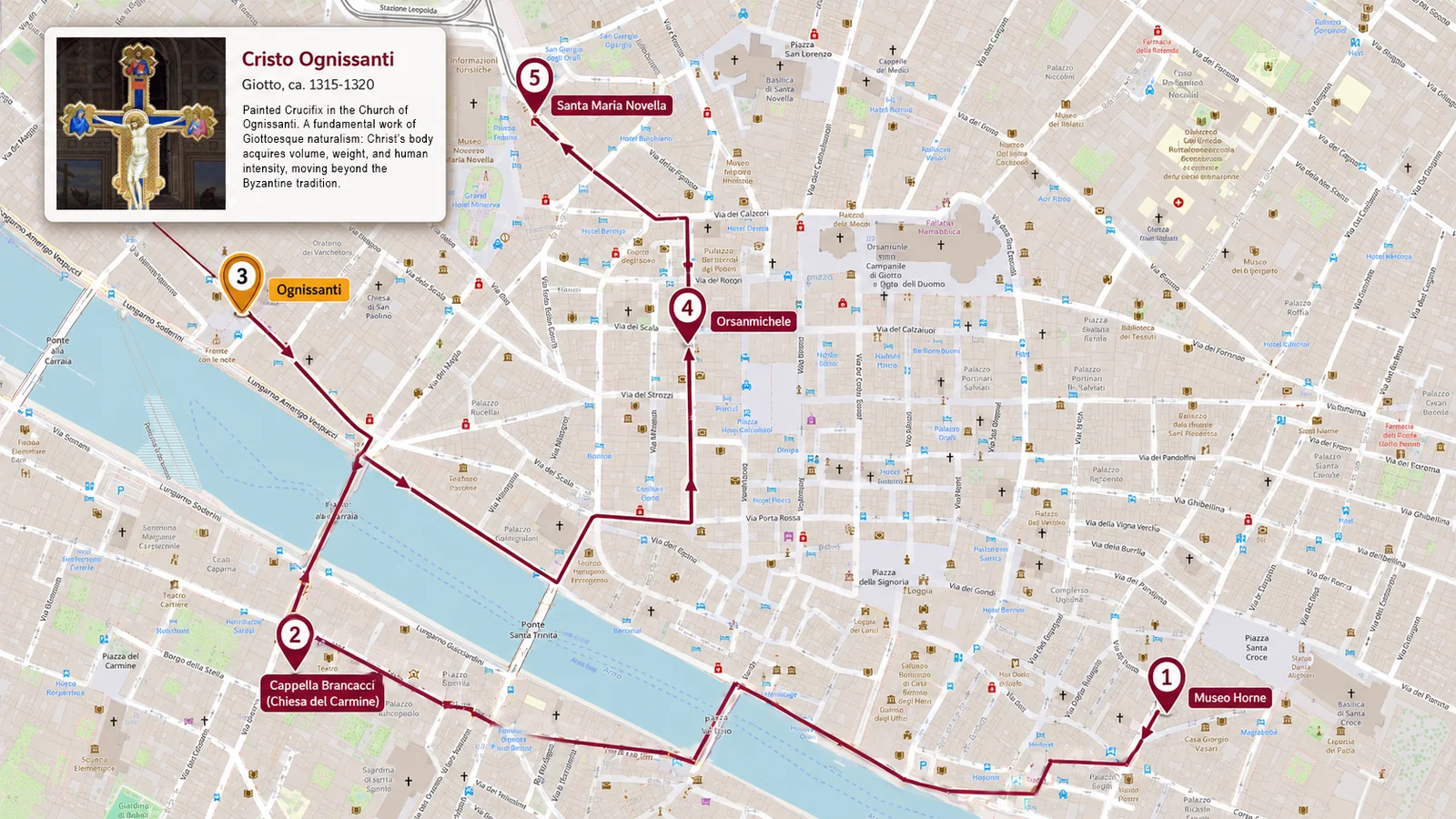
A Flâneur day map of Florence, tracing a route between Museo Horne, the Brancacci Chapel, Ognissanti, Orsanmichele, and Santa Maria Novella, with a card on Giotto’s Ognissanti Crucifix

How a generic AI works

It decides for you, based on what’s statistically popular.

A language model generates an itinerary by predicting what most people would want to see, weighted by how often things appear online. Masterpieces dominate. Niche works disappear. The Uffizi is always suggested. The Brancacci Chapel is sometimes remembered. The Museo Horne is never mentioned.

  • Venues selected by statistical frequency, not curatorial judgment
  • No verified opening hours, no real scheduling logic
  • Works chosen by the model’s priors, not your interests
  • Cannot tell you what a city actually holds
  • High risk of hallucinations: invented opening hours, misattributed works, museums that no longer exist

How Flâneur works

It shows you everything. You choose what to see.

Flâneur starts from a structured database of over 25,000 geolocated works across the cities we cover. Every museum, every church, every collection, catalogued by period, discipline, and curatorial priority. You browse the real inventory. You pin the works you care about. The engine builds around your choices.

  • Every available work shown, not just the famous ones
  • Verified opening hours, weekly closures, scheduling constraints
  • You control what enters your day, including niche discoveries
  • An engine optimises the sequence around your selections

Which profile is yours

How deep do you want to go?

You choose your profile at the start of each itinerary. It determines not just what you see, but how you are asked and how precisely the plan is tailored to you.

Curious

For those who want the masterpieces without a degree in art history

Three questions: city, duration, start date. The engine does the rest, with no artwork selections required. Days are paced to leave room for a walk, a long lunch, or simply sitting in a piazza.

Enthusiast

For those who know the great masters and want to go further

You browse the artists active in your chosen city and pin the ones that count. The engine groups your selections into a logical, timed sequence, balancing depth with time to breathe.

Expert

For those with a formation and a curatorial eye

You filter by discipline and period, browse the entire catalogue, and pin individual works. Every selection shapes the day with surgical precision, reducing idle time between stops to a minimum.


The process

From the browser to the pavement.

01

Choose your city
and your profile.

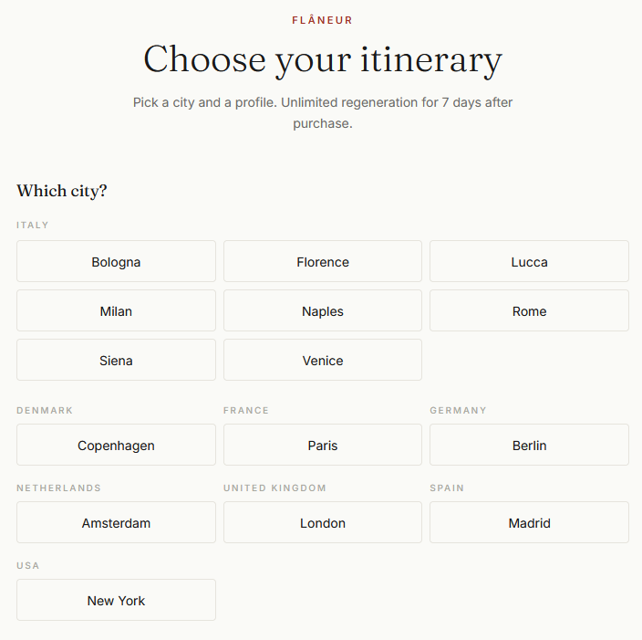
Select where you’re going and tell us how many days you have. We check opening hours, weekly closures, and seasonal exceptions for your exact travel dates. Then choose your depth: Curious puts Flâneur in charge of everything. Enthusiast lets you pick artists and themes. Expert gives you full curatorial control over every work in the catalogue.

The Choose your itinerary screen, with cities grouped by country and a profile to pick
02

Browse the works.
Pin what matters.

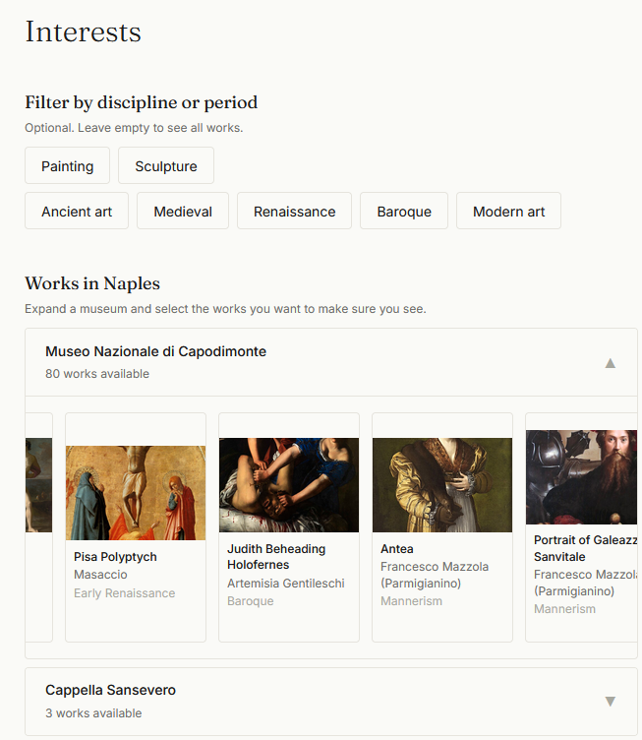
Every museum and collection in the city opens up. You see the actual works, paintings, sculptures, frescoes, with artist, period, and curatorial priority. Including that particular fresco by Ambrogio Lorenzetti that no generalist guide and no AI will ever point you to. Filter by discipline or era. Pin the ones you want to make sure you see. The engine guarantees them a place in your day.

This is the inversion. Instead of receiving what a model decided you should want, you scroll through what the city actually holds and mark your own list.

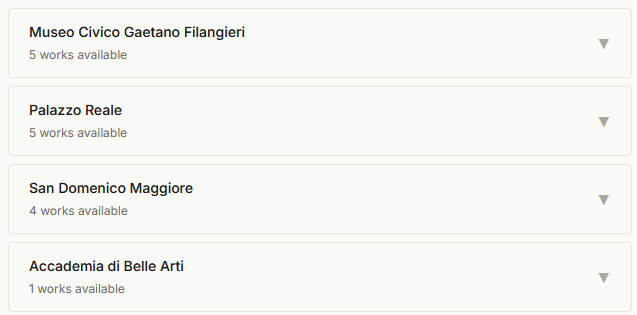
The Interests screen, filtering works by discipline and period, with Capodimonte expanded to show pinnable paintings More Naples museums and collections, each showing how many works are available to browse
03

Set your constraints.
We handle the rest.

Children in tow, reduced mobility, a dislike of queues, a passion for a specific period. Tell us once: the engine takes all of it into account. Day trips to Pompeii or Herculaneum slot in without disrupting the city days. The classic Monday closure is quietly excluded before you ever reach the door.

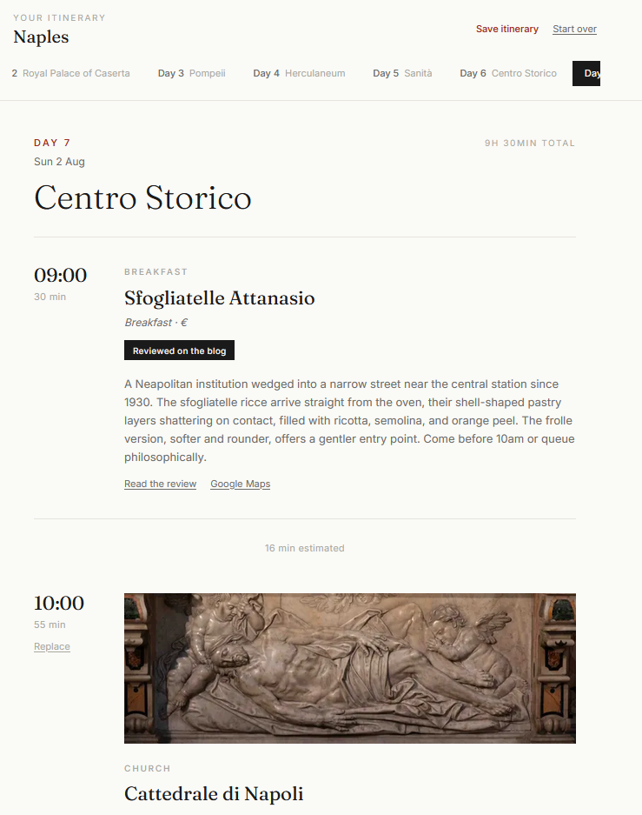
Flâneur takes your pinned works, your available hours, and the verified opening windows of every venue, then constructs a feasible, timed plan. Anchors the heaviest museums in the morning. Groups venues by neighbourhood. The result is a schedule that is actually possible to execute.

A generated day in Naples, the Centro Storico, with breakfast, a church, and verified times laid out hour by hour
04

Review, adjust,
download.

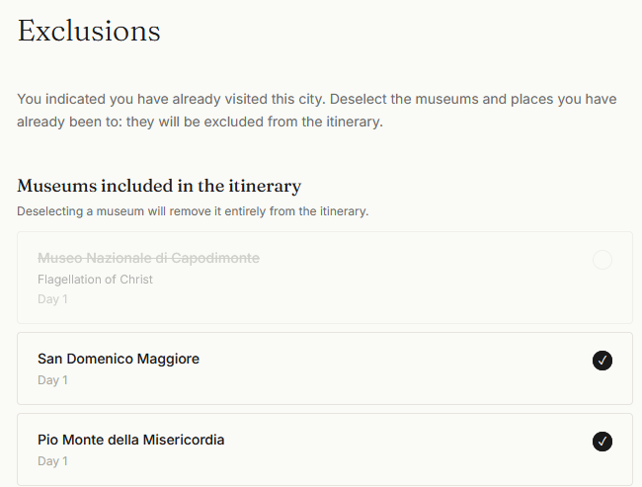
Before the final generation you can exclude places you have already visited, add day trips, and confirm your food preferences. Not happy with a venue once the itinerary is generated? Replace it with a single tap. The plan rebuilds around the new constraints.

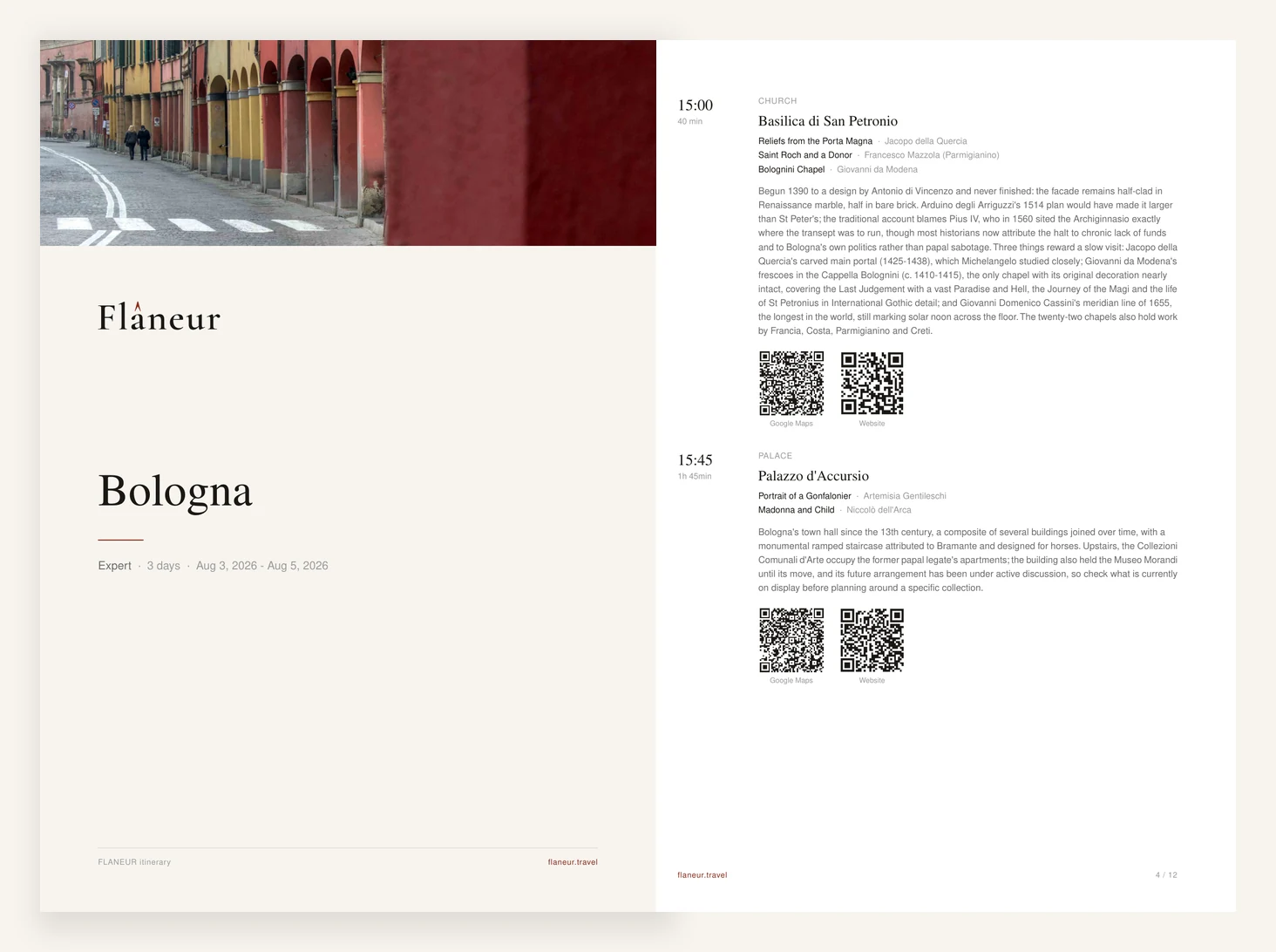
Once you’re satisfied, save it. You get a full PDF with every stop, every work listed by museum, QR codes for Google Maps and venue websites, and food suggestions timed to your position in the day. Where entry requires booking, the venue card carries the direct link, alongside skip-the-line and guided-tour options.

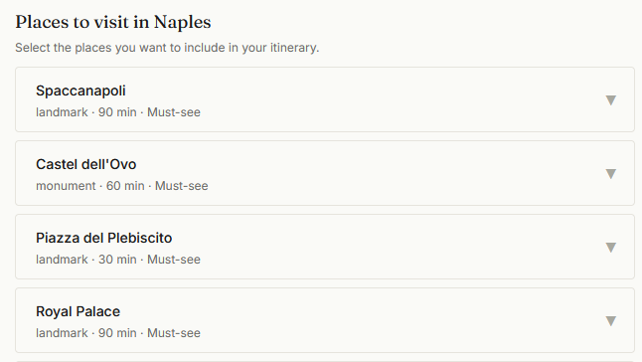
The Exclusions screen, where museums you have already visited are deselected and removed from the itinerary The list of places to visit in Naples, from Spaccanapoli to Castel dell’Ovo, each marked as a must-see
05

Restaurants chosen
with the same seriousness.

Every itinerary includes breakfast, lunch, and dinner suggestions timed and positioned around the day’s art stops. The recommendations come from two distinct sources, and we are transparent about which is which.

Blog-reviewed

Visited and written about first-hand by TheIntroverTraveler. These are rare: we only include a place after eating there ourselves, paying the bill, and finding it worth the recommendation. No sponsored content, no aggregator rankings, no algorithm. A personal selection that grows slowly and does not change to chase trends.

Editorially curated

A wider selection, chosen after cross-referenced research and local input, with a strict no-tourist-trap policy. Not personally verified, but held to the same standard: a place that a well-informed local would actually recommend to a friend visiting for a week. The itinerary labels each restaurant clearly so you always know which category you are looking at.
25,000+
geolocated works catalogued across the cities we cover, classified by period, discipline, and curatorial priority
15
cities covered, each built with the same editorial rigour as the first, verified opening hours included
~200
works classified as unmissable, the absolute masterpieces each city is organised around, always prioritised

The database behind Flâneur is ArtAtlas, built from the ground up over five years of editorial research and, where possible, first-hand visits. When we do not know a fact, we declare it. A different kind of intelligence from a model trained on forum posts.


Now you know
what to expect. Begin.

Five minutes with Flâneur, from €5. We handle the rest.

Start planning